
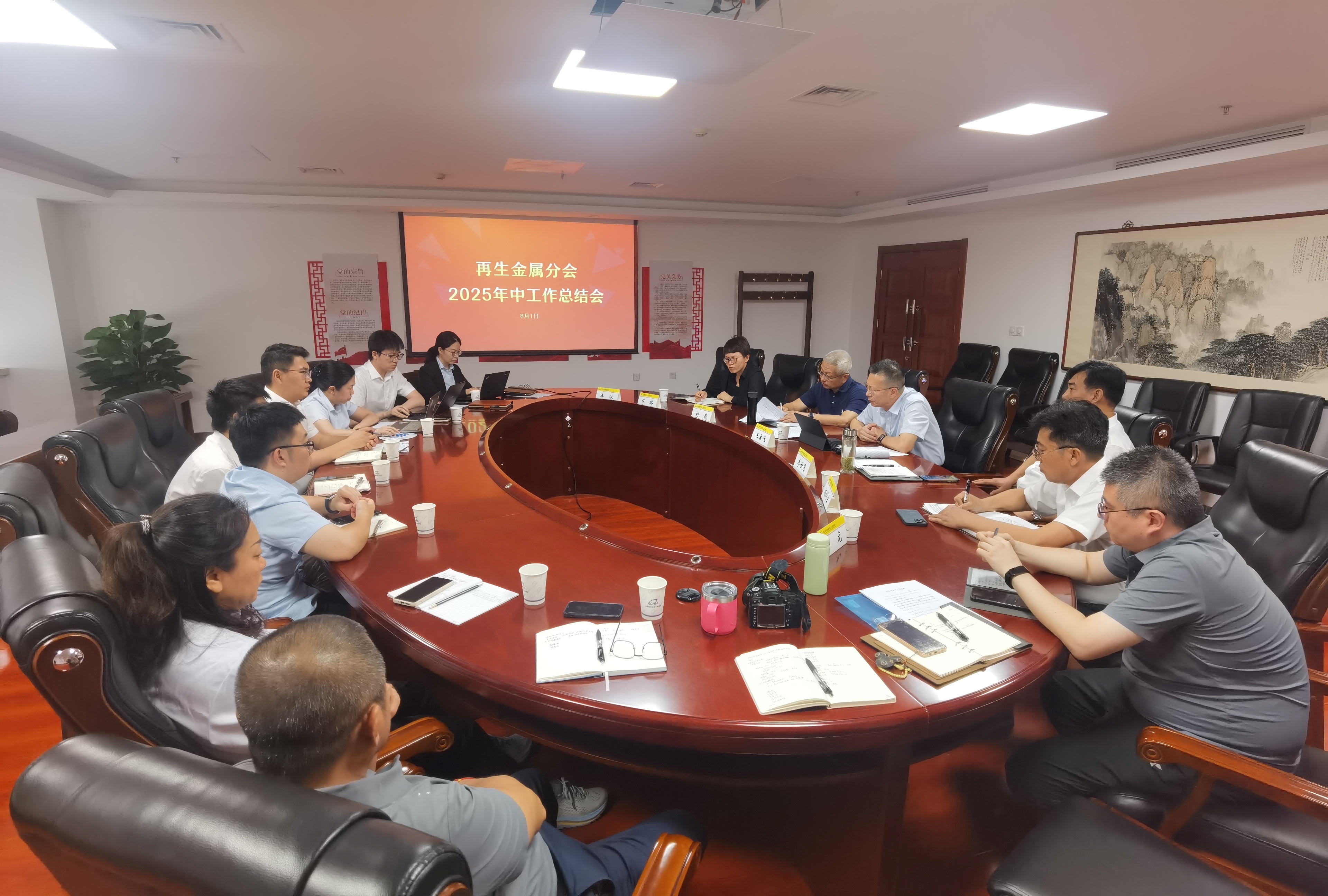
On the afternoon of August 1st, CMRA held its Mid-2025 work exchange meeting. The meeting summarized the work in the first half of the year, analyzed existing problems and outlined significant tasks for the second half of the year. It was chaired by Mr. Wang Jiwei, Deputy Secretary General, Director of Recycling Nonferrous Metals Division, CNIA; Vice President and Secretary General, CMRA. All CMRA staff attended.
Deputy Secretary General Ms. Zhang Lin and Vice President Mr. Liu Wei respectively delivered focused reports on the first-half work of the Industrial Promotion Center and the Industrial Research Center. In the first half, CMRA concentrated on the research of industry’s “15th Five-Year Plan”, conducted in-depth surveys in the fields of recycling copper, aluminium, lead, nickel-cobalt-lithium, and other strategic metal; promoted listing of cast aluminium alloy futures and options, and organized two management training sessions; launched the 2024 ranking of the top 30 recycling nonferrous metals enterprises by revenue; organized delegations to Japan, South Korea, Chile, Argentina, Indonesia, and Malaysia to for international exchanges; promoted the Recycling Metals Green Supply Chain Partner Program through researched in the automobile, electronics and home appliance industries; held a seminar on recycling copper anode plates; and hosted the 2025 ASEAN Recycling Metals International Conference.During the exchange session, participants offered opinions and suggestions on raising safety awareness, optimizing collaboration processes, strengthening research capabilities, broadening and deepening member services, and enhancing the CMRA’s brand influence. Mr. Wang Jiwei responded to each suggestion and provided an analysis of the current situation of recycling metals industry.
Regarding the second half agenda, Mr.Wang set four requirements: firstly, concentrate efforts to complete key tasks; secondly, elevate industry research to a higher strategic level and greater depth, stay aligned with national policies, focus on key sectors, develop outstanding case studies, and support leading enterprises;thirdly, the leadership must take the lead, with all staff acting as “soldiers” in a concerted drive; lastly, explore service innovation, integrate external resources, develop new service methods, and expand the scope of work.
On the afternoon of August 1st, CMRA held its Mid-2025 work exchange meeting. The meeting summarized the work in the first half of the year, analyzed existing problems and outlined significant tasks for the second half of the year. It was chaired by Mr. Wang Jiwei, Deputy Secretary General, Director of Recycling Nonferrous Metals Division, CNIA; Vice President and Secretary General, CMRA. All CMRA staff attended.
Deputy Secretary General Ms. Zhang Lin and Vice President Mr. Liu Wei respectively delivered focused reports on the first-half work of the Industrial Promotion Center and the Industrial Research Center. In the first half, CMRA concentrated on the research of industry’s “15th Five-Year Plan”, conducted in-depth surveys in the fields of recycling copper, aluminium, lead, nickel-cobalt-lithium, and other strategic metal; promoted listing of cast aluminium alloy futures and options, and organized two management training sessions; launched the 2024 ranking of the top 30 recycling nonferrous metals enterprises by revenue; organized delegations to Japan, South Korea, Chile, Argentina, Indonesia, and Malaysia to for international exchanges; promoted the Recycling Metals Green Supply Chain Partner Program through researched in the automobile, electronics and home appliance industries; held a seminar on recycling copper anode plates; and hosted the 2025 ASEAN Recycling Metals International Conference.During the exchange session, participants offered opinions and suggestions on raising safety awareness, optimizing collaboration processes, strengthening research capabilities, broadening and deepening member services, and enhancing the CMRA’s brand influence. Mr. Wang Jiwei responded to each suggestion and provided an analysis of the current situation of recycling metals industry.
Regarding the second half agenda, Mr.Wang set four requirements: firstly, concentrate efforts to complete key tasks; secondly, elevate industry research to a higher strategic level and greater depth, stay aligned with national policies, focus on key sectors, develop outstanding case studies, and support leading enterprises;thirdly, the leadership must take the lead, with all staff acting as “soldiers” in a concerted drive; lastly, explore service innovation, integrate external resources, develop new service methods, and expand the scope of work.



